Mortgage Rate Basics
- Higher credit scores lead to lower interest rates.
- Full Doc loans (where income is verified through tax returns) offer lower interest rates.
- Larger down payments result in lower interest rates.
- If the loan amount is $300,000 or less, the interest rate tends to be higher.
- For smaller loan amounts, an upfront fee may be required.
- If the loan amount is too high (over $1 million), the interest rate may increase and additional fees may be required.
- It is common practice to pay 1 point to lower your interest rate.
Loan Types
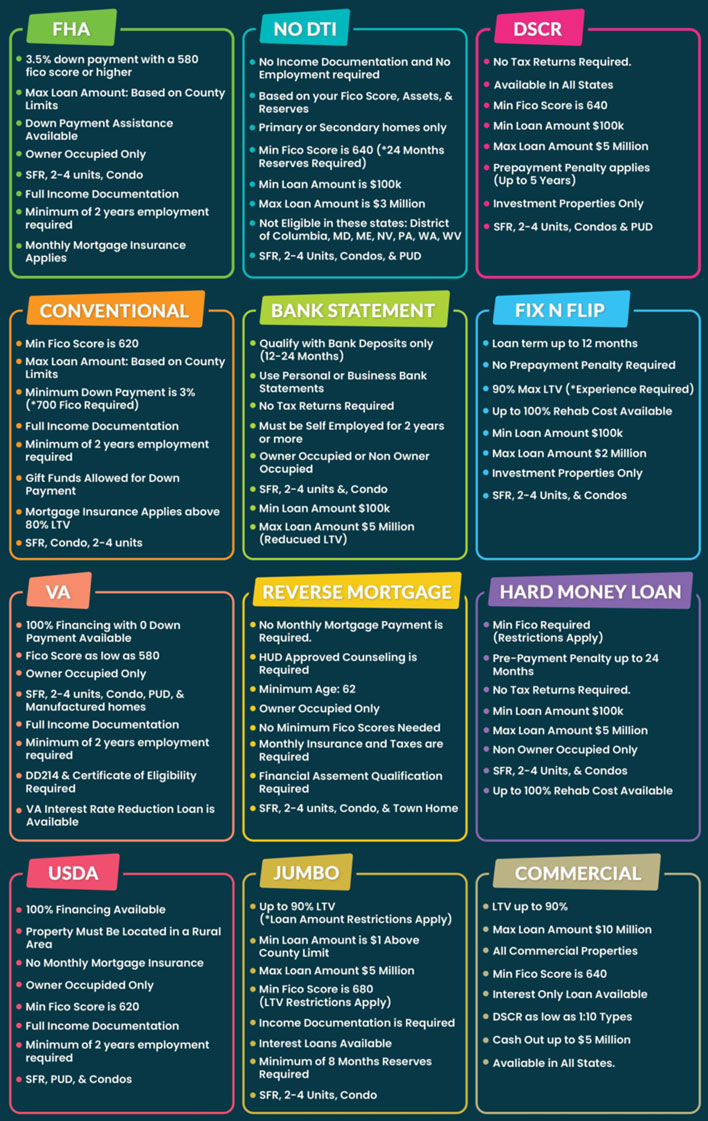
Loan types are actually quite simple. Although there are many varieties as shown in the table above, it ultimately comes down to one question: Can you prove your income using only your tax returns?
- If you can prove your income with just tax returns, it is a Full Doc (QM, Qualified Mortgage) Loan.
- If you cannot, it is a No Doc (Non-QM) Loan.
The difference between the two? The interest rate! QM loans generally offer interest rates that are about 1% lower than Non-QM loans.
Required Tax Documents for Full Doc: Tax Returns (Form 1040), W-2s, and Pay Stubs.
Fixed vs. Adjustable Rates
The interest rate varies depending on whether it is fixed or adjustable. In certain market conditions, adjustable rates may be slightly lower.
Government-Backed Loans
FHA Loans
The most prominent example is the FHA loan, which is insured by the government. Because it is government-backed, it naturally requires various types of documentation.
- Target Audience: Designed mainly for younger buyers who want to purchase a home but haven’t saved enough for a large down payment.
- Pros & Cons: The interest rate is slightly lower. However, you must pay an upfront mortgage insurance premium (typically 1.75%), and you are required to carry monthly mortgage insurance that never automatically drops off.
- Recommendation: If possible, it is highly recommended to save enough for a down payment and secure a conventional loan instead.
VA Loans
These are specialized loans exclusive to military service members and veterans. They feature completely different qualification guidelines, interest rates, and processing steps.
USDA Loans
These loans target specific rural areas. It does not apply to just any rural location; it is restricted to designated geographic zones and operates under a very distinct process.
Other Loan Options
Interest-Only Loans
With this program, you only pay the interest portion of the mortgage for a set period. However, since the principal balance remains untouched, your total interest charges do not decrease over time.
Reverse Mortgages
Available to homeowners aged 62 or older. This program allows you to borrow money against the equity built up in your home.
Refinance
Refinancing simply means replacing your current loan with a new one. This is typically done in a few specific scenarios:
- Rate Reduction: When market interest rates drop below your current rate. It generally makes financial sense if rates drop by 1% or more.
- Cash-Out Refinance: When you need a lump sum of cash. This allows you to replace your current mortgage and extract a portion of your home’s equity as cash.
- Generally, refinancing involves little to no out-of-pocket fees.
How Interest Rates Are Determined
How your mortgage interest rate is determined is also very straightforward. Mortgage rates are customized and applied differently to each individual based on three major criteria: Credit Score, Down Payment Amount, and Loan Amount. Various other secondary factors are then added to adjust the final rate.
To get the standard baseline rate, you typically need a credit score of 740 or higher, a loan amount of $300,000 or more, and a down payment of at least 30% of the home’s value.
If you fall short of these benchmarks, or if the property is not your primary residence (e.g., an investment property, a 2-4 unit multi-family home, or a condo), your interest rate may increase.
Points
Points are another crucial factor. When reviewing mortgage rates from banks, you will often notice terms like “1 point.” If you don’t look closely, it’s easy to miss.
Simply put, a point is a type of upfront fee. Lenders often include fine print stating something like “up to 1.0 discount point.” 1 point equals 1% of your total loan amount. Most traditional banks require a baseline 1% upfront fee by default. Generally, paying 1 point can lower your interest rate by approximately 0.25%.
APR
You will also see the term APR (Annual Percentage Rate). This represents your base interest rate plus the total lender fees associated with processing the loan. It calculates all closing fees as a percentage of the loan amount and adds that to the base rate. Typically, this adds about 0.06% to the rate.
The APR is simply a metric to show how high the loan fees are. There is no need to overanalyze this specific number when choosing your loan.