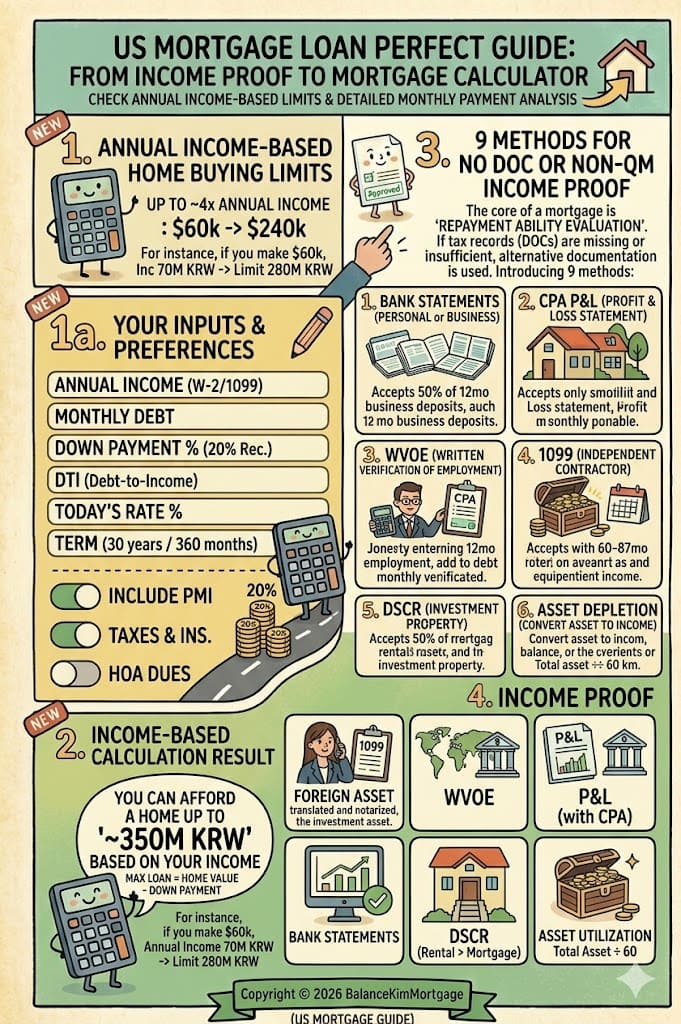
One of the most fundamental aspects of a mortgage loan is income verification. In other words, it is evaluating whether the borrower has the ability to repay the money. If this can be proven through tax returns, that is perfect—no problem. However, if that is not the case, income must be verified through alternative methods. This is where the term Alternative Documentation comes into play.
The following section explains the various ways income can be verified. There are nine total methods, and you can secure a loan using whichever option is viable for your situation.
1. Bank Statements
Instead of tax returns, the lender reviews business or personal bank statements from the most recent 12 months. This is a flagship program for self-employed individuals, where approximately 50% of the total regular deposits into the account are recognized as actual business income to qualify for the loan.
2. CPA P&L
Income is evaluated based on a Profit and Loss (P&L) Statement for the past 1 to 2 years, formally prepared and signed by a CPA or a certified tax professional. Instead of auditing complex, full tax return documents, the lender accepts the net income certified by the accountant as the borrower’s qualifying income.
3. WVOE (Written Verification of Employment)
This program is used when W-2 employees find it difficult to provide tax returns or paystubs. The lender directly verifies the borrower’s current position and salary level using a single, formal Written Verification of Employment (WVOE) form completed directly by the employer. The document is filled out according to a standardized form prepared by the government.
4. 1099
This program is designed for freelancers or independent contractors who earn income under a 1099 form each year. Because 1099 income is only filed with taxes once a year, earnings generated after that filing cannot yet be recognized as tax-proven income. Therefore, this program recognizes income based solely on the 1099 documents before they are officially filed. Generally, 90% or more of the gross amount is counted as income. Concurrently, bank statements are required to verify those funds.
5. DSCR (Debt Service Coverage Ratio)
This is a groundbreaking program used when purchasing an investment property, where the lender completely disregards the buyer’s personal employment or self-employment income. Instead, they grant the loan based strictly on whether the estimated monthly rental income from the target property can cover the mortgage payment (Principal + Interest + Taxes + Insurance). Since this loan is strictly for investment purposes, the buyer cannot occupy the home. (Note: There appears to be a trend where owner-occupancy is exceptionally permitted in certain parts of Florida.)
6. Asset Depletion
This method is tailored for retirees or high-net-worth individuals who do not currently have a regular, recurring stream of income but hold a substantial amount of assets in bank or brokerage accounts. The total assets are divided by a set period (e.g., 60 to 84 months) to hypothetically convert the wealth into a monthly qualifying income. Assets here refer strictly to cash and cash equivalents; real estate is excluded.
7. Foreign Asset / Income
This program is for expatriates and foreign investors who lack a sufficient U.S. income or credit history but hold a job or assets overseas (such as in South Korea). Proof of foreign income or bank balances is translated into English, notarized, and aligned with U.S. mortgage underwriting standards to be formally recognized as qualifying income and down payment funds.
8. No Income No Asset
This is an extremely streamlined program primarily used for purchasing investment properties. The lender completely waives verification of the borrower’s current job income, employment status, and even any post-closing reserve assets beyond the down payment. The file is underwritten solely based on the applicant’s personal credit score and the value of the property being purchased. It typically requires a down payment of 35% or more and a very high FICO score.
9. Asset Utilization
While similar to Asset Depletion, this program uses a different underwriting formula. The lender evaluates the total market value of the stocks, funds, and savings accounts held by a retiree or wealth holder, applies a certain discount rate, and uses the entire lump-sum asset base as evidence of repayment ability. Instead of breaking it down into monthly increments, they approve the loan based on the absolute scale of the assets owned—for example, verifying whether the borrower holds the equivalent of 60 months’ worth of liquid cash. (Caution: Just like Method 6, real estate assets are strictly excluded from the calculation, and only financial assets that can be liquidated immediately are recognized.)