Step 1: Credit Report
A Credit Report does not simply show your score; it provides a detailed record of your entire financial history. If you have a history of delinquency or default on a previous mortgage, it will be very difficult to get approved for a loan. Recent bankruptcies or other major financial issues will also create significant challenges.
A score of 680 or higher is generally acceptable, but 740 or higher is considered stable and secure. The score used is the middle value among those pulled from the three major credit bureaus. If there are two or more applicants, the lower of the two applicants’ middle scores will be used.
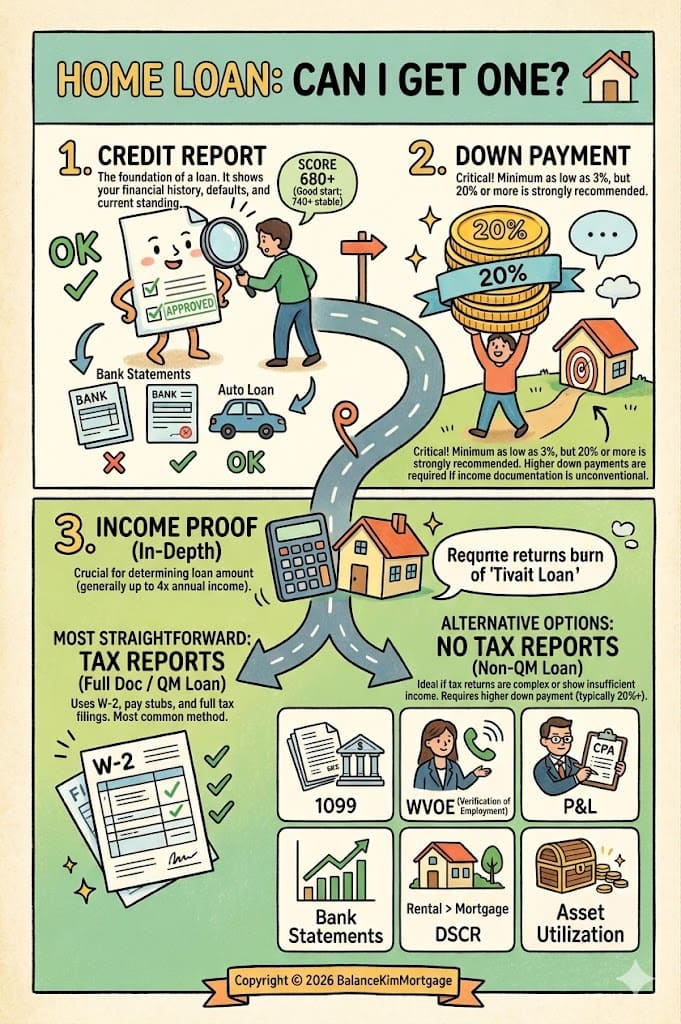
Step 2: Down Payment
The minimum down payment required can start as low as 3%. However, a down payment of around 20% is generally recommended. In particular, if you have not reported a high amount of income on your taxes, lenders will typically require 20% or more.
These first two conditions are straightforward: if you meet them, you are good to go; if not, qualification will be difficult. Even if you pass these steps, the ultimate core factor is the next one.
Step 3: Income
How do you prove your income? The amount you can borrow is roughly 3.5 times your annual income. For example, if your income is $100,000, it means you can generally qualify for a loan amount of around $350,000.
The Simplest Method
The most straightforward approach is using your Tax Returns. This includes your salary and any other regular, recurring sources of income. This is referred to as a Full Doc or QM (Qualified Mortgage) Loan.
If, for any reason, you have not reported sufficient income on your taxes, lenders will skip looking at your tax returns entirely. This is why it is called a No (Income) Doc or Non-QM Loan. These loans usually require a down payment of 20% or more. In this case, how do you prove your income?
Proving Income (Without Tax Returns)
- 1099 – Your total income is calculated by combining all 1099 forms received prior to the tax filing period. Lenders typically recognize 50% to 90% of this amount as qualified income. Bank account records showing these deposits may also be required.
- WVOE (Written Verification of Employment) – For W-2 employees, an employer, HR department, or manager can issue a verification of employment form. The lender will call to verify its authenticity. Typically, they only verify whether you are currently employed rather than the exact salary amount.
- P&L (Profit & Loss Statement) – A CPA or EA (Enrolled Agent) can prepare a simple statement showing your gross revenue, expenses, and net profit from the previous year. The lender will also call the tax professional to verify this document.
- Bank Statements – Lenders review the deposits made into your bank account over the past year and recognize approximately 50% of the total deposits as qualified income.
- DSCR (Debt Service Coverage Ratio) – This applies when purchasing an investment property to rent out, where the projected rental income itself is used as the qualifying income. Lenders typically recognize up to 75% of the rental income to qualify you for the loan.
- Full Doc (Hybrid Approach) – If your tax-reported income is insufficient on its own, this program allows you to combine your tax return income with the alternative methods listed above to meet the requirements.
- Asset Utilization – This is a straightforward method using your liquid assets. Real estate is excluded, but the total value of your current cash and cash equivalents is divided by 60. The resulting figure is counted as your monthly income. For example, if you have $500,000 in qualifying assets, it means you can be credited with roughly $8,300 in monthly income.
Using the details above, you can easily calculate whether you can qualify for a loan.
For Example:
- If your credit score is 692, you put 10% down, and you have $150,000 in tax-reported income, you can borrow approximately $500,000.
- If your credit score is 780, you put 20% down, and you have $150,000 in tax-reported income, you can also borrow roughly $500,000. It’s that simple.
However, what if your credit score is 740, you put 30% down, but your tax-reported income is only $30,000? In that case, you would only qualify for about $100,000. Because buying a home with that specific tax return is unrealistic, you would switch to a No Doc program. You can then secure a loan using one of the alternative methods mentioned above.
Note: Interest rates for No Doc loans are typically 0.5% to 1.5% higher compared to Full Doc loans.