Simply put, closing costs are broken down into three categories:
1. Mortgage Fees – These are the only actual fees for your mortgage. In the list below, this includes exactly these items: 1. Application fee, 2. Loan Origination fee, 3. Credit Report fee, 4. Appraisal fee, 5. Flood Certificate fee, and 6. Tax Service Fee. Depending on the lender, they may also add fees like 7. Underwriting fee, 8. Processing fee, etc. When you look at the document below, all costs under “Loan Costs” up until the “Title” section are the expenses going to the lender. Among these, items 3 through 6 are mandatory and pretty much the same for everyone, and item 2 is the money paid voluntarily to lower your interest rate (points). Therefore, in the specific list below, item 1 is the only money that actually went to the lender. Some lenders might charge extra under names like items 7 and 8.
Simply put, only the items listed under Section A of the Closing Disclosure below are the pure fees paid to the lender.
2. Legal & Government Fees – This covers all legal expenses and taxes related to the property. These are mandatory for everyone and are almost identical across the board.
3. Prepaid & Interest Adjustment Items – Mortgages always run on a calendar basis starting on the 1st of the month. Therefore, the amount you pay upfront varies depending on your closing date. You are essentially pre-paying interest to adjust for the dates. For example, if you close on the 15th, the total of the legal/government fees and these prepaid adjustment costs will typically equal about 1.1% to 1.5% of the home purchase price. If you close on the 2nd, you have to pre-pay almost a full month’s worth of interest, whereas if you close on the 28th, there is very little prepaid interest due at closing. Then, once that initial month passes, you will start making your regular mortgage payments the following month. Mortgage payments are fundamentally paid in arrears (paid backward).
Newspaper Article
I happened to read a newspaper article recently. The headline was about the ongoing debate over mortgage “junk fees.” It made me wonder what exactly this newspaper was thinking, and how much thorough investigative reporting they actually did before publishing such a piece… Reading through it gives the impression that buyers are being hit with massive, completely unnecessary fees. It honestly feels like the reporter has never actually gone through the home buying process themselves.
Below is the content referenced from that article. Underneath it, I have uploaded a Closing Disclosure (CD) from a transaction I personally handled—a complete breakdown of actual fees—to help you better understand what mortgage fees look like in reality. Generally speaking, “closing” refers to the entire journey from starting the contract to the final moment of signing the paperwork and receiving the keys to your home.
(Jump to the next section if you don’t understand Korean.)


Understanding the Closing Disclosure
A Closing Disclosure is a formal statement showing exactly how much money is required and where it is going at the very final stage of the transaction. There are two core pages to focus on.
The First Page
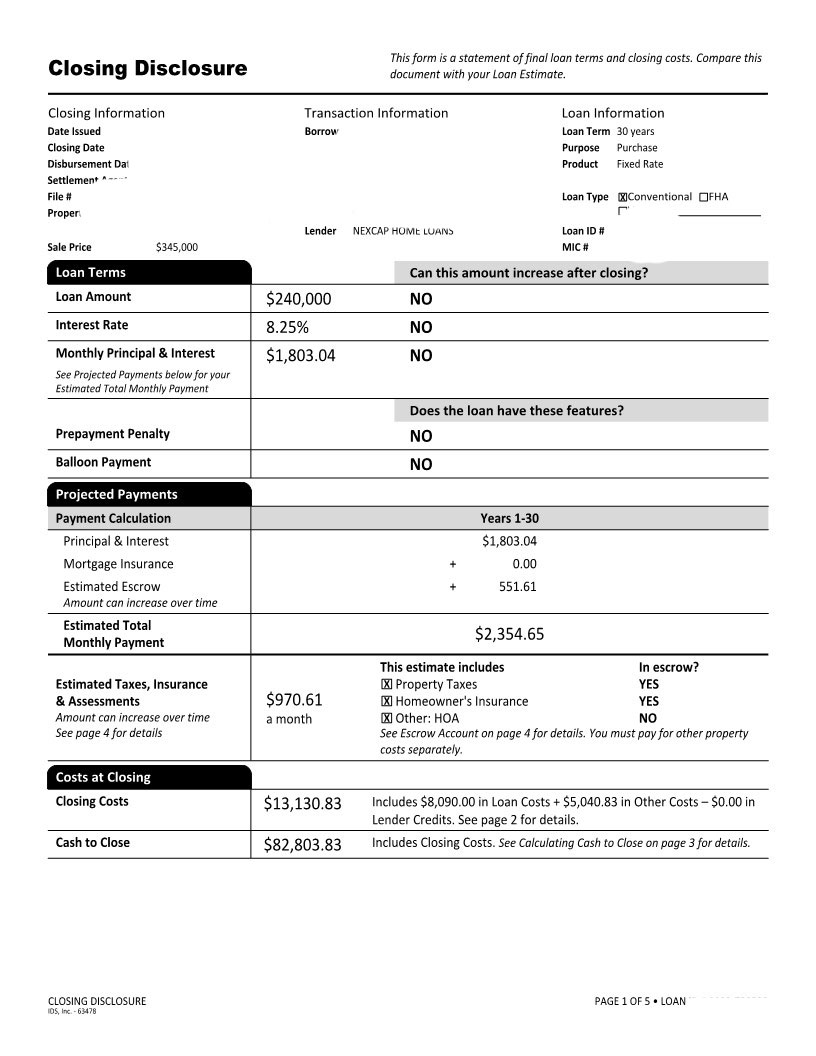
The first page outlines the fundamentals: who is buying the property from whom, the purchase price, the interest rate, the loan term, and what the monthly payment will look like.
According to this specific document, the buyer purchased a $345,000 home with a $105,000 down payment, securing a $240,000 mortgage loan at a 30-year fixed interest rate of 8.25% (this transaction took place when market rates were at their peak). The monthly principal and interest payment comes out to $1,803.04. When you factor in property taxes and homeowners insurance totaling $551.61, the base monthly payment becomes $2,345.65. (The subsequent $970.61 figure indicates that this property is a condo, meaning it includes an HOA management fee. Specifically, subtracting the tax and insurance escrow from that amount—$970.61 – $551.61 = $419—leaves $419 as the monthly condo maintenance fee).
At the very bottom, Closing Costs ($13,130.83) represents the cumulative transaction fees (where $8,090 is directly loan-related, and the rest consists of third-party fees). The Cash to Close ($82,803.83) indicates the final, total dollar amount the buyer must physically bring to the closing table.
The Second Page
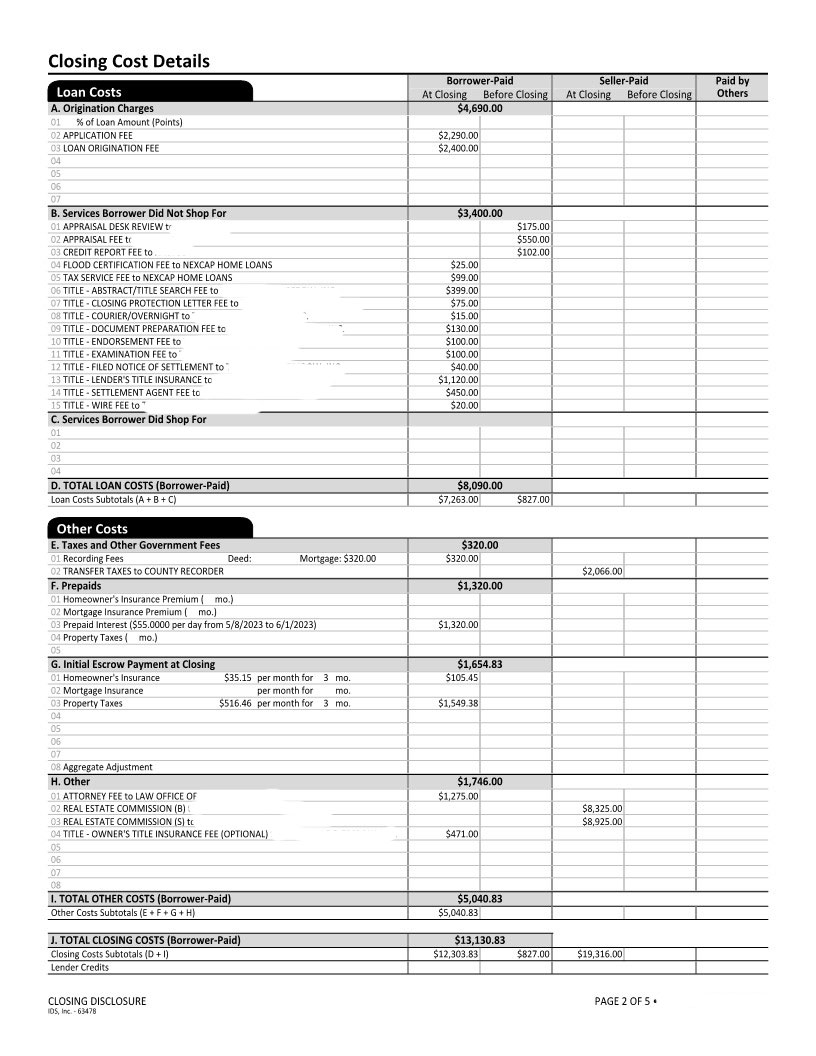
The second page provides an itemized breakdown showing exactly how the above figures were calculated. If you want to understand your transaction fees inside and out, this is the only page you need to look at.
Loan Costs refers strictly to the fees associated with processing the mortgage itself.
- Application Fee: This is the baseline fee charged to initiate and process your loan application.
- Loan Origination Fee: This line item represents the “points” mentioned previously. In this transaction, it was 1 point. (If you choose not to pay this 1 point upfront, you can remove this fee entirely; your interest rate will simply adjust upward by approximately 0.25%. Therefore, excluding this optional point, the actual processing fee directly related to the loan is just the Application Fee of $2,290).
The next three items represent third-party services ordered by the lender to execute the loan:
- Appraisal: This fee goes directly to an independent appraisal company ordered by the lender to verify the market value of the home.
- Credit Report Fee: This is the cost to pull your credit history, which is either paid upfront or charged at closing.
Everything listed up to this point covers what the lender handles directly or orders through outside vendors.
Beneath that, the items categorized under Title all relate to the legal verification of the property. Title work is a mandatory requirement for every single real estate contract. This is managed entirely by a Title Company (typically recommended by the attorney), and this company oversees the administration and explanation of all documents during the final closing meeting.
Further down, you will see Other Costs:
- Section E (Taxes): Government recording fees and transfer taxes.
- Section F (Prepaids): Minor daily interest adjustments required to align your loan schedule with the first day of the upcoming month (since all mortgage calculations run from the first to the last day of the month).
- Section G (Escrow): Initial reserves collected for homeowners insurance and property taxes.
- Section H (Other): Attorney fees and miscellaneous closing charges.
In Conclusion
As you can clearly see from the breakdown above, mortgage companies do not blindly overcharge you or slip in hidden “junk fees.” Every single line item is fully transparent, thoroughly disclosed, and explained one by one at closing. If a lender attempted to pad the numbers or overcharge you, it would be instantly visible on these documents.
Admittedly, predatory practices did happen in the past, which ultimately triggered the financial crisis of 2008. However, because the industry introduced strict licensing systems and rigorous regulatory oversight immediately following that collapse, you no longer have to worry about being blindsided by hidden fee explosions.